Introduction
In this example, we check the correctness of SFEMaNS for a hydrodynamic problem with variable density and dynamical viscosity involving Dirichlet boundary conditions. The variables are all made dependant of the azimuthal component (nonaxisymmetric setting). The mass equation is not approximated. We consider a level set, solution of the same advection equation, that is used to reconstruct the density and the other fluid's properties.
We solve the level set equation:
\begin{align*} \partial_t \varphi + \bu \cdot \GRAD \varphi = f_\varphi. \end{align*}
We recontruct the density and dynamical viscosity as follows:
\begin{align*} \rho=\rho_1+(\rho_2-\rho_1) F(\varphi), \\ \eta=\eta_1+(\eta_2-\rho_1) F(\varphi), \end{align*}
with \(\eta_i\) and \(\rho_i\) data to define. The function \(F(\varphi)\) is either the identity (called linear reconstruction) or a piece-wise polynomial function (called reg reconstruction).
We solve the Navier-Stokes equations with the momentum \(\bm=\rho\bu\) as dependent variable:
\begin{align*} \partial_t\bm + \DIV(\bm\otimes\bu) - \frac{2}{\Re} \DIV(\eta \epsilon(\bu)) +\GRAD p &=\bef, \\ \DIV \bu &= 0, \\ \bu_{|\Gamma} &= \bu_{\text{bdy}} , \\ \bu_{|t=0} &= \bu_0, \\ p_{|t=0} &= p_0, \end{align*}
where \(\epsilon(\bu)=\frac{1}{2}(\GRAD \bu + \GRAD^s \bu)\) is the strain rate tensor.
These equations are solved in the domain \(\Omega= \{ (r,\theta,z) \in {R}^3 : (r,\theta,z) \in [0,1] \times [0,2\pi) \times [-1,1]\} \) with \(\Gamma= \partial \Omega \). The data are the source terms \(f_\varphi\) and \(\bef\), the boundary data \(\bu_{\text{bdy}}\), the initial datas \(\bu_0\) and \(p_0\). The parameter \(\Re\) is the kinetic Reynolds number, the densities \(\rho_i\) and the dynamical viscosities \(\eta_i\).
Remarks:
-
The level set and the momentum equations can be stabilized with the entropy viscosity method used in test 15 (called LES).
-
For physical problem, the level set has to take values in [0,1] such that the interface is represented by \(\varphi^{-1}(\{1/2\})\). The fluids area are respectively represented by \(\varphi^{-1}(\{0\})\) and \(\varphi^{-1}(\{1\})\). Notice that this test does not consider immiscible fluids. It involves manufactured solution with a smooth variable density.
-
A compression term can also be added in the level set equation. This term allows the level set to remains sharp near the fluids interface represented by \( \varphi^{-1}(\{1/2\}) \).
We refer to the section Extension to multiphase flow problem for more details on the algorithms implemented in SFEMaNS for multiphase problem.
Manufactured solutions
We approximate the following analytical solutions:
\begin{align*} u_r(r,\theta,z,t) &= r \cos(t)\sin(2\theta)/2, \\ u_{\theta}(r,\theta,z,t) &= 3 r \cos(t)/2 + r \cos(t) \cos(2\theta)/2, \\ u_z(r,\theta,z,t) &=1 , \\ p(r,\theta,z,t) &= r^2 z^3 \cos(t) + r^2 \cos(t-z)\sin(\theta) + r z \sin(t-r)\cos(2\theta), \\ \varphi(r,\theta,z,t) &= 0.5 + (\cos(t-z) + \sqrt{2}\cos(\sqrt{2}\sin(t)) r \cos(\theta) +\sin(\sqrt{2}\sin(t)) r \sin(\theta))/8, \\ \rho(r,\theta,z,t) &=1 + 99\varphi(r,\theta,z,t), \\ \eta(r,\theta,z,t) &=1 + 99\varphi(r,\theta,z,t). \end{align*}
where the source terms \(f_\varphi\), \(\bef\) and the boundary data \( \bu_{\text{bdy}}\) are computed accordingly.
Generation of the mesh
The finite element mesh used for this test is named RECT20.FEM and has a mesh size of \(0.05\) for the P1 approximation. You can generate this mesh with the files in the following directory: ($SFEMaNS_MESH_GEN_DIR)/EXAMPLES/EXAMPLES_MANUFACTURED_SOLUTIONS/RECT10_form after modifying the topology file. The following image shows the mesh for P1 finite elements.
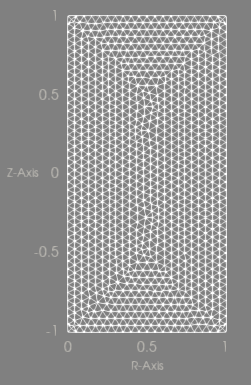
Finite element mesh (P1).
|
Information on the file condlim.f90
The initial conditions, boundary conditions and the forcing terms are set in the file condlim_test_40.f90. Here is a description of the subroutines and functions of interest.
-
The subroutine
init_velocity_pressure initializes the velocity field and the pressure at the time \(-dt\) and \(0\) with \(dt\) being the time step. This is done by using the functions vv_exact and pp_exact as follows: DO j = 1, 6
!===velocity
END DO
DO j = 1, 2
!===pressure
phin_m1(:,j,i) = pn_m1(:,j,i) - pn_m2(:)
phin (:,j,i) = Pn (:,j,i) - pn_m1(:,j,i)
ENDDO
ENDDO
-
The function
init_level_set initializes the level set at the time \(-dt\) and \(0\) with \(dt\) being the time step. This is done by using the function level_set_exact as follows: DO j = 1, 2
END DO
END DO
END DO
-
The function
vv_exact contains the analytical velocity field. It is used to initialize the velocity field and to impose Dirichlet boundary conditions on the velocity field.
-
First we define the radial and vertical coordinates r, z.
-
We define the velocity field depending of its TYPE (1 and 2 for the component radial cosine and sine, 3 and 4 for the component azimuthal cosine and sine, 5 and 6 for the component vertical cosine and sine) as follows:
vv = 0.d0
IF (m==0) THEN
IF(TYPE==3) THEN
vv = 1.5d0*r*COS(t)
ELSE IF (TYPE==5) THEN
vv = 1.d0
ELSE
vv = 0.d0
END IF
ELSE IF (m==2) THEN
IF (TYPE==2) THEN
vv = 0.5d0*r*COS(t)
ELSE IF (TYPE==3) THEN
vv = 0.5d0*r*COS(t)
ELSE
vv = 0.d0
END IF
ELSE
vv = 0.d0
END IF
RETURN
-
The function
pp_exact contains the analytical pressure. It is defined as follows. IF (m==0.AND.TYPE==1) THEN
vv(:) = rr(1,:)**2*rr(2,:)**3*COS(t)
ELSE IF (m==1 .AND. TYPE==2) THEN
vv = rr(1,:)**2*COS(t-rr(2,:))
ELSE IF (m==2 .AND. TYPE==1) THEN
vv = rr(1,:)*rr(2,:)*SIN(t-rr(1,:))
ELSE
vv = 0.d0
END IF
RETURN
-
The function level_set_exact is used to initialize the level set.
-
We define the level set of the mode and its TYPE (1 for cosine and 2 for sine) as follows:
IF (interface_nb==1) THEN
IF (m==0 .AND. TYPE==1) THEN
vv = 0.5d0 + 0.125d0*COS(t-z)
ELSE IF (m==1 .AND. TYPE==1) THEN
vv = 0.125d0*SQRT(2.d0)*COS(SQRT(2.d0)*SIN(t))*r
ELSE IF (m==1 .AND. TYPE==2) THEN
vv = 0.125d0*SIN(SQRT(2.d0)*SIN(t))*r
ELSE
vv = 0.d0
END IF
-
If more than one level set is considered, the computation is stopped.
ELSE
CALL
error_petsc(
' BUG in level_set_exact, we should compute only 1 level set')
END IF
RETURN
-
The function
source_in_NS_momentum computes the source term \(\bef\) of the Navier-Stokes equations.
-
The function
source_in_level_set computes the source term \(f_\varphi\) of the level set equations. It is equal to zero.
All the other subroutines present in the file condlim_test_40.f90 are not used in this test. We refer to the section Fortran file condlim.f90 for a description of all the subroutines of the condlim file.
Setting in the data file
We describe the data file of this test. It is called debug_data_test_40 and can be found in the following directory: ($SFEMaNS_DIR)/MHD_DATA_TEST_CONV_PETSC.
-
We use a formatted mesh by setting:
===Is mesh file formatted (true/false)?
.t.
-
The path and the name of the mesh are specified with the two following lines:
===Directory and name of mesh file
'.' 'RECT20.FEM'
-
We use four processor in the meridian section. It means the finite element mesh is subdivised in four.
===Number of processors in meridian section
4
-
We solve the problem for \(4\) Fourier modes.
===Number of Fourier modes
4
-
We use \(4\) processors in Fourier space.
===Number of processors in Fourier space
4
-
We do not select specific Fourier modes to solve.
===Select Fourier modes? (true/false)
-
We approximate the Navier-Stokes equations by setting:
===Problem type: (nst, mxw, mhd, fhd)
'nst'
-
We do not restart the computations from previous results.
===Restart on velocity (true/false)
.f.
-
We use a time step of \(0.00125\) and solve the problem over \(400\) time iterations.
===Time step and number of
time iterations
0.00125d0, 400
-
We do not apply mass correction on the level set.
===Do we apply mass correction? (true/false)
-
We do not kill the overshoot of the level set with respect of the interval \([0,1]\).
===Do we kill level set overshoot? (true/false)
-
We use P2 finite element to approximate the level set.
===Do we use P2 finite element
for level_set? (
true/
false)
.t.
-
We use a BDF1 approximation of the time derivative in the momentum equation.
===Do we solve momentum with bdf2 (true/false)?
.f.
-
We use a BDF2 approximation of the time derivative in the level set equation.
===Do we solve level set with bdf2 (true/false)?
.t.
-
We use an artificial compression technique to approximate the Navier-Stokes equations.
===Solve Navier-Stokes with art comp scheme (true) or (false)?
.t.
-
We set the penalty coeffcient for the artifical compression method.
===Penalty coefficient for artifical compression
1.0d0
-
We set the number of domains and their label, see the files associated to the generation of the mesh, where the code approximates the Navier-Stokes equations.
===Number of subdomains in Navier-Stokes mesh
1
===List of subdomains for Navier-Stokes mesh
1
-
We set the number of boundaries with Dirichlet conditions on the velocity field and give their respective labels.
===How many
boundary pieces
for full Dirichlet BCs on velocity?
3
===List of
boundary pieces
for full Dirichlet BCs on velocity
2 4 5
-
We use the momentum as dependent variable for the Navier-Stokes equations.
===Solve Navier-Stokes with u (true) or m (false)?
-
We set the kinetic Reynolds number \(\Re\).
-
We use the entropy viscosity method to stabilize the level set equation.
===Use LES? (true/false)
.t.
-
We use the entropy viscosity method to stabilize the momentum equation.
==Use LES in momentum? (true/false)
.t.
-
We define the coefficient \(c_\text{e}\) of the entropy viscosity.
===Coefficient multiplying residual
1.0d0
-
We give information on how to solve the matrix associated to the time marching of the velocity (or momentum in this case).
-
===Maximum number of iterations
for velocity
solver100
-
===Relative tolerance
for velocity
solver1.d-6
===Absolute tolerance
for velocity
solver1.d-10
-
===Solver type for velocity (FGMRES, CG, ...)
GMRES
===Preconditionner type for velocity
solver (HYPRE, JACOBI, MUMPS...)
MUMPS
-
We give information on how to solve the matrix associated to the time marching of the pressure.
-
===Maximum number of iterations
for pressure
solver100
-
===Relative tolerance
for pressure
solver1.d-6
===Absolute tolerance
for pressure
solver1.d-10
-
===Solver type for pressure (FGMRES, CG, ...)
GMRES
===Preconditionner type for pressure
solver (HYPRE, JACOBI, MUMPS...)
MUMPS
-
We give information on how to solve the mass matrix.
-
===Maximum number of iterations
for mass matrix
solver100
-
===Relative tolerance
for mass matrix
solver1.d-6
===Absolute tolerance
for mass matrix
solver1.d-10
-
===Solver type for mass matrix (FGMRES, CG, ...)
CG
===Preconditionner type for mass matrix
solver (HYPRE, JACOBI, MUMPS...)
MUMPS
-
We solve the level set equation.
===Is there a level set?
.t.
-
We want to consider one level set \(\varphi\), so we set: We note this test does not consider two immiscible fluids.
-
We use compression the compression technique to get a sharp interface between immiscible fluids.
===Compression factor for level set
1.d0
-
We define the parameters \((\rho_1,\rho_2)\) used to reconstruct the density.
===Density of fluid 0, fluid 1, ...
1.d0 100.d0
-
We define the parameters \((\eta_1,\eta_2)\) used to reconstruct the dynamical viscosity.
===Dynamic viscosity of fluid 0, fluid 1, ...
1.d0 100.d0
-
We define a multiplier coefficient.
===multiplier for h_min for level set
1.d0
inputs%h_min_distance. It can be used in the condlim file to set the wideness of the initial interface. It is not used in this case as the level set does not represent an interface between two immiscible fluids.
-
We use a linear reconstruction, meaning \(F(\varphi)=\varphi\).
===How are the variables reconstructed from the level set function? (lin, reg)
'lin'
-
We set the number of boundaries with Dirichlet conditions on the level set and give their respective labels.
===How many
boundary pieces
for Dirichlet BCs on level
set?
1
===List of
boundary pieces
for Dirichlet BCs on level
set4
-
We give information on how to solve the matrix associated to the time marching of the level set.
-
===Maximum number of iterations
for level
set solver100
-
===Relative tolerance
for level
set solver1.d-6
===Absolute tolerance
for level
set solver1.d-10
-
===Solver type for level set (FGMRES, CG, ...)
GMRES
===Preconditionner type
for level
set solver (HYPRE, JACOBI, MUMPS...)
MUMPS
-
To get the total elapse time and the average time in loop minus initialization, we write:
===Verbose timing? (true/false)
.t.
lis when you run the shell debug_SFEMaNS_template.
Outputs and value of reference
The outputs of this test are computed with the file post_processing_debug.f90 that can be found in the following directory: ($SFEMaNS_DIR)/MHD_DATA_TEST_CONV_PETSC.
To check the well behavior of the code, we compute four quantities:
-
The L2 norm of the error on the velocity field.
-
The H1 norm of the error on the velocity field.
-
The L2 norm of the error on the level set.
-
The L2 norm of the error on the pressure.
These quantities are computed at the final time \(t=0.5\). They are compared to reference values to attest of the correctness of the code. These values of reference are in the last lines of the file debug_data_test_40 in the directory ($SFEMaNS_DIR)/MHD_DATA_TEST_CONV_PETSC. They are equal to:
============================================
(RECT20.FEM)
===Reference results
8.7749796248369450E-004 L2 error on velocity
1.0482305912429532E-002 H1 error on velocity
2.6353807435704957E-005 L2 error on level set
8.1493730051115043E-002 L2 error on pressure
To conclude this test, we show the profile of the approximated level set, density, pressure and velocity magnitude at the final time. These figures are done in the plane \(y=0\) which is the union of the half plane \(\theta=0\) and \(\theta=\pi\).

Level set in the plane plane y=0.
|

Density in the plane plane y=0.
|

Pressure in the plane plane y=0.
|

Velocity magnitude in the plane plane y=0.
|

 1.8.11
