
In summer 2022, I participated in the ROOT program at the National Museum of Mathematics. I served as a docent of the museum and got to work with a number of mathematically interesting exhibits and share some interesting ideas with the public! Here are some cool pictures of my favorite exhibits:

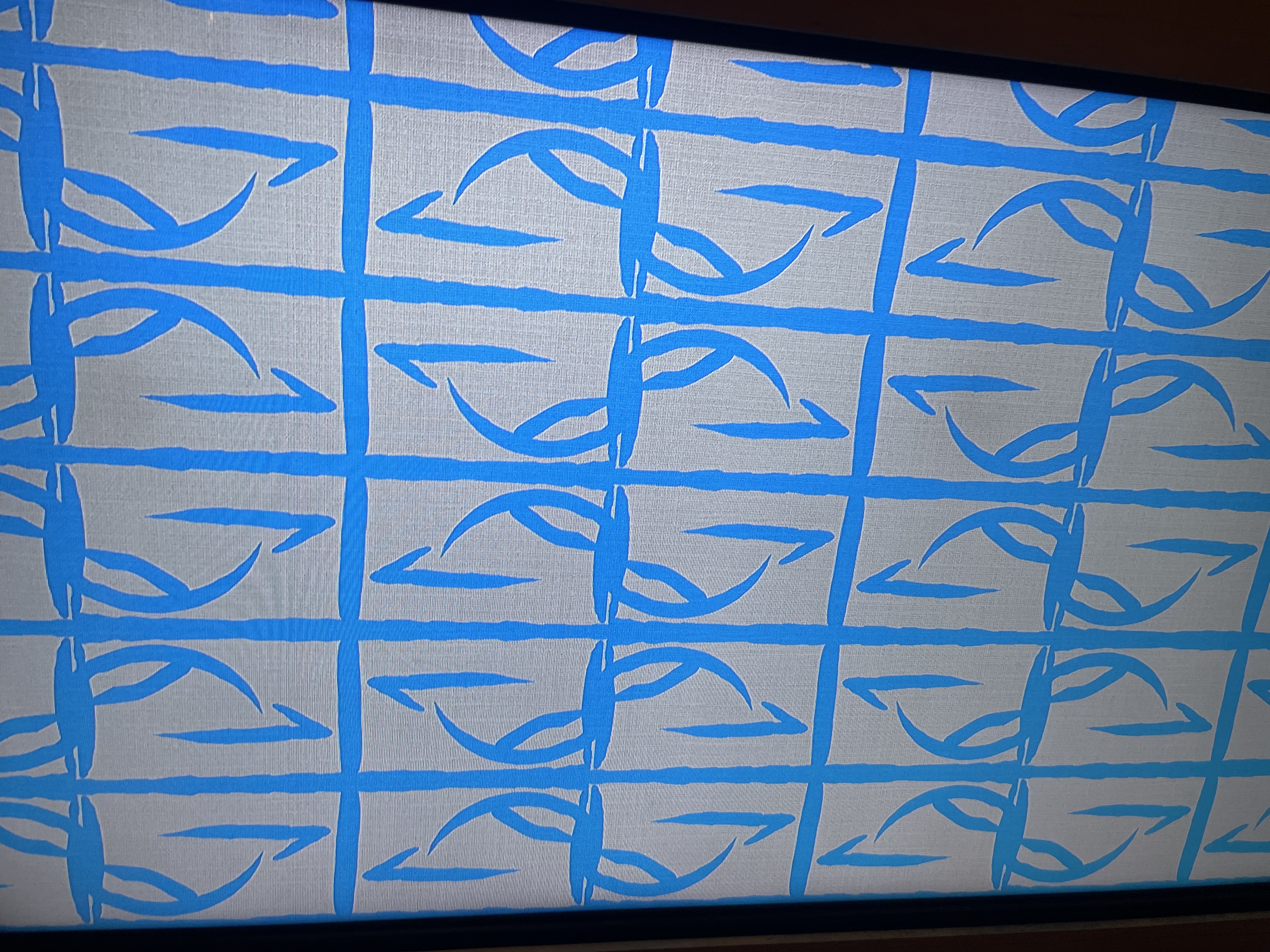
The first exhibit, Polypaint, is a personal favorite. Pre-school-aged kids all the way up to adults not only enjoy the novelty of the exhibit, but it also serves to demonstrate some very interesting mathematics, accessible to even the youngest guests. The visitors would draw on the large canvas, and their strokes would be repeated according to one of the 17 possible 2D plane symmetries. If a visitor seemed interested, I would explain the orbifold of the torus using examples like Asteroids (if they were old enough to remember) or Pacman.


Feedback Fractals is one of the harder exhibits to demonstrate to young kids, but I found it to be a favorite among guests (and myself) in the end. I also find the methods the exhibit uses to generate fractals to be quite elegant. The exhibit uses three cameras which are all aimed at a wall, upon which the camera feed is being projected. Most of us are familiar with the feedback effect produced when one points a camera at its own feed, but this particular setup allows the user to point the camera at the images of three different feeds. One of the most intriguing things about fractals is how simple the rules to generate them tend to be. For instance, the Sierpinski triangle (first picture) is generated when all the cameras are pointed at a central point, and the projections are arranged in a triangle around it. Therefore, each camera picks up all three feeds and sends it to its own projector. Those familiar with fractals likely see where this is going...
top